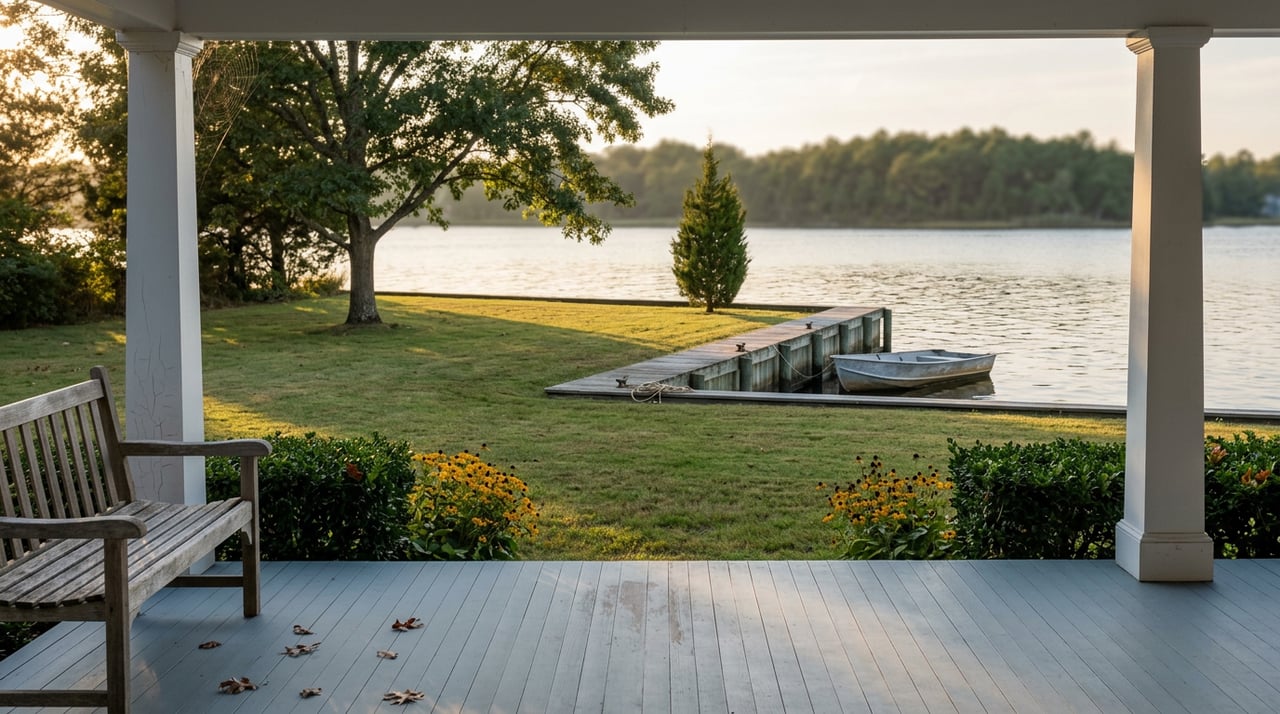
A house on Union Avenue in Center Moriches went on the market this year at $1,995,000, and the listing spent its opening line not on the kitchen or the four bedrooms but on a filing cabinet detail: "DEC-Designated Upland Boundary Waterfront, Build Right to the Bulkhead, DEC Documentation on File." Over 100 feet of bulkhead, deep water access, 1.39 private acres along Senix Creek. The house is real and so is the price, but the sentence doing the heaviest lifting in that listing isn't about the house at all. It's about paperwork.
That's the part buyers scrolling waterfront listings on Moriches Bay tend to miss. Two homes can sit on the same bay, offer the same boat access, and still be worth six figures apart, and the difference often has nothing to do with square footage. It has to do with whether the seller can prove, on paper, where their buildable land stops and New York State's jurisdiction over tidal wetlands begins.
The Same Bay, Two Different Price Tags
East Moriches and Center Moriches sit on the same body of water, a few minutes apart by car, both feeding into the same inlet system. As of this September, waterfront listings in the two hamlets tell noticeably different stories.
| East Moriches | Center Moriches | |
|---|---|---|
| Waterfront homes currently listed | 12 | 21 |
| Median waterfront listing price | $1.02 million | $820,000 |
| Typical days on market | 36 | 50 |
The gap isn't really about which hamlet is "better." East Moriches has fewer waterfront homes on the market at any given time, which alone tightens pricing. But talk to anyone who has shopped both markets and the conversation turns quickly to bulkheads, permits, and septic systems, not schools or commute times. Those are the variables that decide whether a specific waterfront parcel is worth its asking price, and they don't show up in a price-per-square-foot column.
What "DEC Documentation on File" Actually Buys You
New York's Department of Environmental Conservation regulates activity in tidal wetlands, which on Moriches Bay means the strip of land closest to the water on almost every waterfront lot. A bulkhead marks the line, at least in theory, between land you can freely build on and land the state treats as regulated wetland.
In practice, that line isn't always documented. A homeowner who inherited a decades-old bulkhead may have no paperwork establishing where DEC's jurisdiction actually starts, which means any future dock repair, bulkhead replacement, or addition near the water triggers a permitting process from scratch. DEC's own guidance on bulkhead repairs draws a hard distinction between "in-kind, in-place" work, replacing an existing structure in its same footprint, which typically qualifies for the faster Standard Activity Permit, and anything involving waterward expansion, which gets treated as a new shoreline stabilization project and can require a full individual permit along with a state coastal consistency review.
That distinction is exactly why the Union Avenue listing leads with its paperwork. A documented jurisdictional boundary tells a buyer, before they've hired a surveyor or filed a single application, that the upland portion of the lot is confirmed usable and outside DEC's permit requirements. Without that documentation, a buyer is purchasing uncertainty along with the water view. They won't know for sure what they can rebuild, expand, or repair until they've gone through the same process the seller could have completed years earlier.
That uncertainty gets priced in. It shows up as a longer time on market, a lower offer, or a contingency that slows the closing while a buyer's attorney sorts out what the bulkhead actually permits.
The Bay Itself Is Part of the Appraisal
There's a second variable that matters just as much and gets talked about even less: what's happening underneath the house.
The Moriches Bay Project, a nonprofit founded in 2012 by Westhampton residents Laura Fabrizio and Aram Terchunian, has spent more than a decade seeding oysters into Moriches Bay specifically because the water quality that makes waterfront property desirable in the first place has been under pressure. The group runs a floating oyster nursery, known as a FLUPSY, in the Senix area of East Moriches, one of four it operates across the bay system. Each oyster filters roughly 50 gallons of water a day, and the project has planted well over a million of them into local waters.
Dwight Surgan, one of the project's cofounders, was blunt about the cause in a September 2025 interview with Dan's Papers: aging septic and cesspool systems are the bay's main source of nitrogen, feeding the algae blooms that show up along the shoreline in warmer months. It's not a hypothetical problem for one property. It's a collective one, and it means the condition of the wastewater system underneath a waterfront lot isn't just a code compliance question at closing. It's connected to the reason people want to own on the bay at all: clean water, active clamming grounds, a healthy Moriches Inlet for boat access out to the ocean.
Buyers who skip a close look at a waterfront home's septic or cesspool system, especially on older lots that predate current standards, are skipping the exact detail that determines both their own future maintenance costs and, in aggregate, the long-term health of the water their house sits on.
What This Means If You're Comparing Listings
If you're weighing two waterfront homes that look similar on paper, the questions that actually separate them rarely show up in the listing photos.
- Ask for the bulkhead's permit history, not just its visual condition. A seller with a documented DEC jurisdictional boundary can usually produce it on request.
- Ask whether any dock, float, or bulkhead work was done "in-kind" or involved any waterward expansion. That single distinction determines whether future repairs move quickly or require a fresh individual permit.
- Ask the age and type of the septic or cesspool system, and whether it's been upgraded to a newer low-nitrogen design. This affects both your closing costs and your long-term relationship with the water in front of the house.
- Compare access type honestly. A home with private frontage carries different obligations than one relying on public access points like Great Gun Marina or the Maple Avenue boat ramp, or club access through Moriches Bay Yacht Club. None of these are worse choices, but they're different financial and maintenance pictures.
None of this shows up in a median price. It shows up in the file folder a seller can, or can't, hand over during due diligence.
A Few Questions Worth Asking Directly
Does a lower price on a Center Moriches waterfront listing mean it's a worse property than a comparable East Moriches home? Not necessarily. The wider inventory in Center Moriches, 21 waterfront listings compared to East Moriches's 12 as of this September, gives buyers more to choose from, which naturally spreads pricing further. The permit and wastewater condition of the specific lot matters more than which hamlet it sits in.
Can I find out a property's DEC jurisdictional status before I make an offer? Yes, though it usually requires either an existing survey with the boundary documented, as in the Union Avenue example, or a new site visit and application if no prior determination exists. This is worth raising with your attorney early rather than discovering it during a post-contract inspection period.
Is a documented bulkhead boundary worth negotiating over? It's worth understanding, at minimum. A seller who has already secured that documentation has removed a real source of future cost and delay, and that has value. A seller who hasn't isn't necessarily hiding anything, but the buyer should factor in the time and expense of establishing it themselves.
Waterfront pricing on Moriches Bay isn't as simple as square footage and a water view. The properties that hold their value, and sell in fewer than the current 36 to 50 day range, tend to be the ones where the seller already did the paperwork the next owner would otherwise have to chase.
If you're comparing waterfront listings in East Moriches, Center Moriches, or anywhere along the bay, Donna Lomenzo can help you look past the listing photos to the permit history, the wastewater system, and the details that actually determine what a property is worth. Reach out to request your free home valuation and get a clear read on where a specific listing stands.